
LONDON, UK. September 1st, 2026 – More than half of the fires recorded by the London Fire Brigade during the latest twelve-month reporting period began in refuse containers, loose rubbish or domestic gardens, according to a new borough-level analysis published today by RiskFire. The figures highlight how strongly London’s fire burden is being shaped by outdoor and refuse-related incidents, particularly during periods of hot, dry weather.
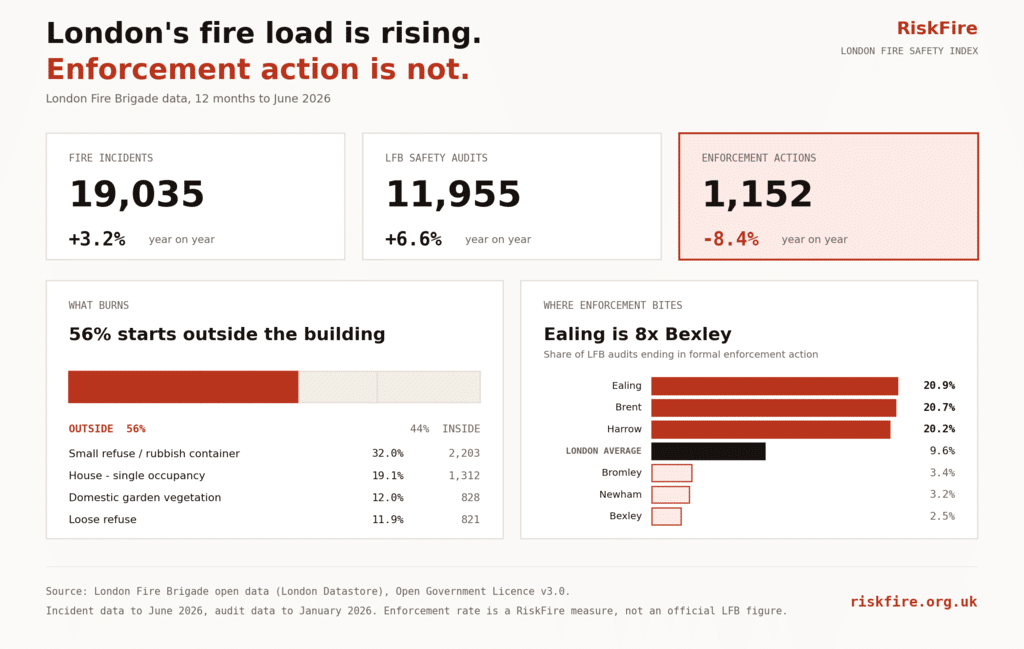
These categories are among those most vulnerable to elevated temperatures and dry conditions, and together now account for the majority of London’s recorded fire incidents. Small refuse and rubbish container fires represent 32 per cent of incidents, with 2,203 fires recorded. Domestic garden vegetation accounts for 12 per cent, while loose refuse contributes a further 11.9 per cent.
By comparison, fires in single-occupancy houses represent 19.1 per cent of incidents. Fires in purpose-built flats of up to nine storeys account for a combined 24.9 per cent.
The seasonal variation is significant. July 2025 was the busiest month in the current reporting window, with 2,138 fires, while February 2026 recorded the lowest total at 935. The summer high was therefore approximately 2.3 times the winter low.
Overall, the number of fire incidents increased by 3.2 per cent during the period, reaching 19,035. The reporting window also covers the heatwaves experienced in May and June 2026.
At the same time, formal enforcement action by the London Fire Brigade declined by 8.4 per cent to 1,152 actions. Risk-based fire safety audits, however, increased by 6.6 per cent to 11,955. As a result, the proportion of audits leading to formal enforcement fell by 1.6 percentage points to approximately 10 per cent.
Fire exposure is not evenly distributed across London. Newham recorded 889 fires during the period, followed by Westminster with 886 and Brent with 768. At the lower end of the scale, Kensington and Chelsea recorded 276, Kingston upon Thames 273 and the City of London 89. South London recorded 4,119 fires, compared with 3,356 in East London.
Enforcement outcomes also differed substantially between boroughs. Ealing recorded an enforcement rate of 20.9 per cent of audits, compared with just 2.5 per cent in Bexley. The London-wide rate was 9.6 per cent. For managing agents operating buildings across different boroughs, the likelihood of an audit resulting in formal action can therefore vary considerably.
A spokesperson for the RiskFire editorial team said: “The fire picture in London looks different from what many people might expect. A majority of the incidents attended by the Brigade begin outside the building, particularly in bins, loose refuse and gardens. These are also the categories most likely to increase during hot, dry periods, while the underlying level of dwelling fires changes much less.
“If summers become hotter, these outdoor and refuse-related categories are likely to be among the first parts of the fire profile to respond. At the same time, enforcement action has declined despite increases in both incidents and audits.”
The Index cautions against interpreting a single year as evidence of a long-term trend. Weather-sensitive categories can fluctuate considerably from month to month, and RiskFire recommends using the five-year series when assessing the overall direction of travel rather than relying solely on a twelve-month period.
Responsible persons for blocks of flats and managed premises can check their borough’s audit, enforcement and incident figures in the Index, and find a register-verified fire risk assessor covering their postcode.
The Index is free to use, updated monthly, and the underlying series can be downloaded as CSV and JSON.

