LONDON, UK. October 13th, 2026 – Seasonal menus and retail promotions can go beyond the expected this autumn, with six creative combinations of European speciality foods and drinks giving businesses fresh ideas for showcasing regional products, inspiring customers and adding interest to familiar occasions.
As temperatures fall and autumn produce comes into focus, consumers often gravitate towards comforting meals, mature flavours and ingredients suited to sharing. This creates an opening for shops, cafés, bars and restaurants to explore new combinations that bring something different to seasonal shopping and dining.
European products with Protected Designation of Origin (PDO) or Protected Geographical Indication (PGI) status provide an additional point of interest. These labels recognise the connection between products and their geographical origins, alongside relevant production requirements. Retailers and hospitality businesses can use these qualities to build engaging stories around authenticity, tradition and flavour.
Through its More Than Only Food & Drink campaign, the EU presents six pairing ideas that demonstrate how European food and drink specialities can inspire autumn merchandising and menu development.
Parmigiano Reggiano PDO from Italy and chocolate
Combining cheese and chocolate offers a different take on premium indulgence. Mature Parmigiano Reggiano PDO, made from raw cow’s milk in its designated northern Italian production area, develops its characteristic flavour through traditional production and at least 12 months of maturation. Its savoury, nutty and gently caramelised notes provide a counterpoint to chocolate’s roasted cocoa profile, allowing sweet and salty flavours to complement one another.
For retailers: Build a premium seasonal feature around Parmigiano Reggiano PDO and quality European chocolate. The products could be presented as a discovery set, incorporated into gift hampers or sold in smaller portions for autumn entertaining.
For hospitality: Offer the pairing as a small after-dinner tasting, an accompaniment to coffee or an alternative to standard petit fours.
Pêra Rocha do Oeste PDO and Prosciutto di Parma PDO
The combination of juicy pear and delicately cured ham is well suited to autumn entertaining. Pêra Rocha do Oeste PDO is grown in Portugal’s Oeste region, where local conditions help shape its sweetness, crisp texture and natural juiciness. Prosciutto di Parma PDO comes from the Parma area of Italy and is made through traditional curing and maturation using selected pork legs and sea salt. Together, the fresh fruit and silky, savoury ham offer a balance of textures and flavours, particularly when the pear is warmed to intensify its sweetness.
For retailers: Create a convenient seasonal food pairing by displaying the pear and ham with artisan bread and complementary cheeses. Suggested recipes for crostini, warm salads and sharing plates could encourage customers to purchase the ingredients together.
For hospitality: Incorporate the combination into a starter, flatbread, autumn salad or sharing platter, using fresh pear for brightness or roasted pear for a richer flavour.
Tokaji PDO from Hungary and Roquefort PDO from France
For customers interested in discovering new flavour combinations, Tokaji PDO and Roquefort PDO offer a meeting of sweetness, acidity and savoury intensity. Tokaji PDO wines originate in Hungary’s historic Tokaj region and follow production requirements associated with the area and its specified grape varieties. Roquefort PDO is produced from sheep’s milk and matured in the natural caves of Roquefort-sur-Soulzon, France. The local maturation environment contributes to the cheese’s blue veins, creamy consistency and bold taste. The wine’s fruity sweetness and refreshing acidity help offset the saltiness of Roquefort, while its honeyed notes add another dimension to the pairing.
For retailers: Merchandise the wine and cheese together with crackers, fruit and preserves to provide a complete cheeseboard solution. Informative shelf-edge materials can highlight the balance of flavours and explain the significance of the products’ PDO designations.
For hospitality: Recommend Tokaji PDO with Roquefort PDO on a cheese menu, offer the combination as a dedicated course or feature it in a guided tasting of European wines and cheeses.
Swedish Aquavit PGI with roast pork and apple
Traditional botanical flavours give Swedish Aquavit PGI a distinctive role in autumn food pairing. Produced in Sweden and characterised by caraway and/or dill, the spirit reflects established Swedish flavouring traditions and a defined geographical connection. Its herbal profile works alongside the savoury notes of roast pork, while apple brings a bright, sweet and slightly acidic contrast to richer cuts of meat.
For retailers: Bring Swedish Aquavit PGI together with pork, apples and pickled accompaniments in a Nordic-inspired seasonal display. Simple serving ideas can show customers how the products work together as a complete meal.
For hospitality: Suggest a small serving of aquavit with roast pork, pork belly or sausage, accompanied by apple and pickled vegetables. The combination could form part of a Nordic-inspired menu or a seasonal bar-food selection.
Gouda Holland PGI from the Netherlands and coffee
Aged Gouda Holland PGI and coffee offer an alternative to the familiar combination of hot drinks with cakes and biscuits. To carry the designation, Gouda Holland must be produced in the Netherlands using milk from Dutch dairy farms and naturally matured there. Mature cheese develops buttery, nutty and caramel-like characteristics that complement coffee’s roasted flavours, while its creamy texture helps balance bitterness.
For retailers: Introduce the pairing near premium coffee, breakfast products and autumn brunch selections. Tasting notes and serving suggestions can encourage shoppers to try mature cheese in a new context, while gift bundles could bring both products together.
For hospitality: Serve mature Gouda Holland PGI with speciality coffee as a savoury alternative to a sweet snack, or introduce the pairing as an unconventional final course in a restaurant.
Dark České pivo PGI from Czechia and chocolate pudding
Chocolate pudding and dark beer can work together through their shared roasted and caramel notes. Dark varieties of České pivo PGI from Czechia offer malt richness and a characteristic bitterness that can balance a sweet dessert. The beer’s connection to Czech brewing tradition is recognised through its PGI status, which reflects defined production practices and quality ingredients. Carbonation provides further contrast with the pudding’s dense or creamy consistency.
For retailers: Pair selected dark beers with premium chocolate, brownies and desserts in displays aimed at autumn entertaining. Short food-matching notes can explain why a beer with roasted flavours and balanced bitterness works well with chocolate.
For hospitality: Recommend a dark České pivo PGI alongside chocolate pudding, tart or brownie, or create a tasting experience that explores different beer and dessert combinations.
LONDON, UK. October 13th, 2026: Listening to employees is most effective when their feedback leads to meaningful action. In a new webinar from People Insight, Southbank Centre will share how it is bringing employee listening and 360 feedback together to support accountability, leadership development and organisational improvement. The session will give HR and people development professionals an insight into how the UK’s largest arts centre, home to Royal Festival Hall, is working to make feedback an integral part of its organisational culture.
Building a Culture of Feedback: Inside Southbank Centre’s Listening & 360 Journey will take place on Thursday 29th October 2026, from 11.00 to 12.00 noon GMT. Southbank Centre’s Courtney Caton, Internal Communications and Engagement Manager, and Luke Jackson, Learning & Development Manager, will join host Costa Antoniou, Senior Consultant at People Insight, for a candid conversation about bringing organisation-wide listening and individual development together.
Gathering employee feedback is an important first step, but its value depends on how organisations respond. HR and L&D teams need to translate employee perspectives into clear priorities, relevant development opportunities and tangible improvements.
During the webinar, speakers will discuss how Southbank Centre connects insights into the overall employee experience with feedback that supports individual awareness, learning and development.
Accountability will be a key part of the discussion. The speakers will consider how organisations can keep progress moving after collecting feedback, establish clear ownership and ensure that subsequent actions are visible to employees.
Tom Debenham, Managing Director of People Insight, said: “Employee listening and leadership development are often treated as separate activities. Bringing them together helps organisations connect what employees experience with how their leaders behave, then take responsibility for what changes next.
“We’re delighted to welcome Southbank Centre to explore that connection and share practical ideas for making feedback part of how an organisation works.”
Attendees will take away ideas for connecting organisation-wide listening with individual development, encouraging greater participation and embedding accountability into follow-up activity. The session will also explore approaches that organisations can adapt, including listening cadence, 360 feedback and action planning.
The webinar is intended for HR, L&D and organisational development professionals who want to create a stronger link between employee voice and people development.
Organisations reviewing their employee listening strategy or preparing to introduce a 360 feedback programme will have the opportunity to hear from practitioners putting these approaches into practice within a major cultural institution.
Those joining the live session will also discover further opportunities to explore the topic and translate the discussion into practical next steps.
WARRINGTON, UK. October 13th, 2026: People aged 25 to 34 are now the largest group seeking accountancy support, with nearly one in two prospective clients under the age of 35, according to new data highlighting the changing face of entrepreneurship in the UK.
Research analysing 9.2 million UK director appointments by company formation agent 1st Formations shows that the average age of a UK founder has remained around 43 for more than 25 years.
However, figures from UK accountancy provider Caroola Accountancy indicate that people are increasingly exploring business ownership earlier in life, with those aged 25 to 34 representing the largest proportion of people looking for accountancy services.
Caroola analysed the ages of visitors to its website between July and October 2026. Those aged 25 to 34 accounted for 27% of visitors, followed by the 35 to 44 age group at 20% and those aged 18 to 24 at 19%. Overall, 46% were under 35, while 66% were younger than 45.
The 1st Formations research found that the average age of company founders remained between 41 and 44 each year from 2000 onwards. The figure returned to 43 in both 2024 and 2025, marking the first significant decline in more than a decade. The research is based on director appointments and therefore reflects individuals establishing limited companies.
Other studies also highlight the appetite for entrepreneurship among younger generations. Research published in 2025 by business finance provider Capital on Tap found that 82% of UK adults aged 18 to 24 were considering starting their own business. Its analysis of Companies House data also identified Manchester as the UK city with the highest concentration of founders aged 24 and under.
Caroola believes the findings reflect a growing number of people setting up businesses, freelance operations and side projects earlier in their working lives. They also suggest that more aspiring entrepreneurs are turning to professional advisers from the outset.
Akosua Catherine Akobeng, Head of Accountancy Growth at Caroola Accountancy, said: “What we’re seeing today is a new generation of entrepreneurs entering the market much earlier in their careers. Young professionals are increasingly building side hustles, freelance businesses and limited companies alongside traditional employment, and many are seeking professional accountancy support from day one. For many first-time business owners, getting an accountant is one of the first steps they take after deciding to go self-employed.
“The growth we’re seeing among younger demographics reflects a broader shift in entrepreneurship. Starting and running a business is more accessible than ever before, and younger founders are looking for digital-first services that help them stay compliant, save time and focus on growing their business.”
Caroola anticipates that this shift will influence the services entrepreneurs expect from professional firms. Fast access to advice, adaptable support and technology that makes complex tasks easier are likely to become increasingly important, alongside traditional annual compliance services.
LONDON, UK, October 13, 2026: The Accessible Events Show returns to Wembley this October with a programme focused on tackling barriers to inclusion across the events industry. The one-day event will bring together leading voices from organisations including ICC Wales, The Business of Events, Mash Media and Ringrose Law, alongside the launch of new research examining the gap between accessibility commitments and the experiences of event attendees.
The Accessible Events Show, the UK’s only dedicated event bringing together professionals working to make events accessible and inclusive, takes place at The Drum, Wembley, on 29 October 2026. Following an award-winning debut year that secured two major industry accolades, this year’s programme combines expert-led discussions in the morning with practical workshops throughout the afternoon.
New research highlights the scale of accessibility challenges
The event begins with the presentation of Access All Areas: Closing the Accessibility Gap in Events, a research project commissioned by ICC Wales in partnership with The Business of Events and developed with Dr Shani Dhanda, accessibility consultant and co-founder of the Accessible Events Show.
Supported by the All-Party Parliamentary Group for Events, the research draws on a survey of 1,000 delegates aged 18 to 65, conducted by market research agency 3Gem in June 2025, as well as contributions from more than 100 venues.
The findings reveal that 93% of disabled delegates encounter barriers when attending events, while almost one in three event attendees identify as having a visible or non-visible disability. The report outlines ten recommendations designed to help the industry bridge the divide between accessibility provisions and the experiences of those attending events.
Amy Phillips, Director of Sales at ICC Wales, and Lesley Whyte, Associate Director at Davies Tanner and The Business of Events, will introduce the findings and explore the reasons behind the disconnect between industry commitments and the realities faced by delegates.
Industry experts lead a packed programme
The morning sessions will examine how accessibility can be embedded into event planning and delivery. Josh Waddell and Ashlea Gilfoy from ROAR B2B will join Gina Kay of media partner Mash Media to discuss practical approaches to accessibility at two major UK exhibitions, Naidex and Confex.
The programme also features the panel discussion From Good Intentions to Accessible Action, bringing together professionals who are working to turn accessibility commitments into meaningful change. Carrie Clewes, Partner and Equality and Disability Rights Lawyer at Ringrose Law, will lead a legal briefing on medical cannabis in venues and at events.
In the afternoon, delegates can take part in interactive sessions designed to help them put inclusive practices into action. Catherine Grinyer, Director of Attendable and co-founder of the show, will lead Stress-test Your Event, helping participants assess their event planning through an accessibility lens.
A session on access services will feature Orla Pearson, co-founder of the show and Director of MyClearText and AccessLOOP, alongside Karen Green of Interpreting Matters and Claire Saddleton, CEO of VocalEyes.
Jonathan Hassell, CEO and Lead Consultant at Hassell Inclusion, will present Is Your Event Really Digitally Accessible?, exploring accessibility considerations for registration platforms, digital content and hybrid events. The programme concludes with Creating More Neuroinclusive Events, led by Andy Williamson, Founder of Welcome Brain Consulting.
Advancing accessibility across the events industry
With more than 16 million disabled people in the UK and 1.3 billion worldwide, accessibility is a significant issue for the events sector. Creating inclusive experiences is both a professional responsibility and a commercial consideration, with accessible design helping ensure more people can participate fully.
Dr Shani Dhanda, co-founder of the Accessible Events Show, said: “Winning two awards in our first year told us something important: the events industry is ready for this. This year’s agenda is our most practical yet, real research, real case studies and real people leading sessions on what actually works. We cannot wait to bring everyone together at Wembley in October.”
About the organisers and event partners
The Accessible Events Show is organised by Catherine Grinyer of Attendable, Orla Pearson, co-founder and Director of MyClearText and AccessLOOP, and Dr Shani Dhanda, accessibility consultant and broadcaster.
Operating as a not-for-profit company limited by guarantee, the show reinvests all proceeds into initiatives that support greater accessibility throughout the events industry.
The 2026 event partners are HSBC, AccessLOOP, Accessible Surveys, Attendable, CrowdComms, EventWell®, Interpreting Matters Ltd, Mash Media, MyClearText, Performedia, Dr Shani Dhanda, Swagable, Silent Seminars and Apple Sound Ltd.
Candlestick pattern trading is one of the most widely used approaches to technical analysis. Traders use candlestick formations to interpret price behaviour, identify possible reversals confirm continuation moves and understand how buyers and sellers are interacting at important market levels.
Candlestick charts are useful because they compress open, high, low and close data into a visual format that can be understood quickly. However, candles only show the outcome of trading activity. They do not reveal the full depth of liquidity sitting in the order book or how aggressively buyers and sellers are transacting at specific prices.
That is where platforms such as Bookmap can add more context. Bookmap visualises liquidity, order flow and traded volume in real time, allowing traders to examine what is happening behind the candlestick rather than relying only on its shape.
Japanese candlestick chart analysis
Japanese candlestick chart analysis focuses on the relationship between a candle’s open, high, low and close. Each candle contains a body and, in most cases, one or two wicks. The body represents the difference between the opening and closing price, while the wicks show the highest and lowest prices traded during that period.
A bullish candle generally closes above its opening price. A bearish candle closes below it. The most important part of candlestick analysis is context. A hammer appearing after a strong decline near support may have a very different meaning from the same hammer appearing randomly in the middle of a trading range.
Traders should therefore consider: ● Previous trend direction ● Support and resistance ● Volume ● Volatility ● Market structure ● Timeframe ● Liquidity around the pattern
Bookmap can complement Japanese candlestick analysis by showing where liquidity was positioned before, during and after a candle formed. This can help traders understand whether a strong-looking candle was associated with meaningful market participation.
Reading candle formations for market timing
Candlestick formations are often used to help traders decide when to pay closer attention to a market. They should not, however, be treated as perfect timing tools.
A bullish engulfing pattern, for example, may suggest that buying pressure is increasing, but this does not automatically mean price will continue higher. The formation becomes more meaningful when it appears at an important support level, after a clear decline or alongside increasing volume.
Good market timing usually requires several pieces of evidence. Traders may consider: ● Where the pattern forms ● Whether price is trending or ranging ● Whether volume supports the move ● Whether the next candle confirms the signal ● Whether liquidity is building or disappearing nearby
Using Bookmap alongside candlesticks can provide another layer of information by showing order-book liquidity and executed volume around important price areas.
Candlestick price action setups
There are many candlestick price action setups, but some appear more frequently in trading strategies than others.
1. Bullish engulfing at support
A bullish engulfing pattern occurs when a bullish candle covers the body of the previous bearish candle.
It can be more significant when it develops near established support after a downward move.
2. Bearish engulfing at resistance
This is the opposite formation.
A bearish candle engulfs the body of the previous bullish candle, potentially signalling that sellers are becoming more aggressive.
3. Hammer after a sell-off
A hammer has a relatively small body and a long lower wick.
It suggests price traded significantly lower during the period before buyers pushed it back towards the top of the range.
4. Shooting star after a rally
A shooting star has a long upper wick and relatively small body.
It may indicate rejection of higher prices.
5. Morning star reversal
A morning star is a three-candle bullish reversal structure that commonly appears after a decline.
6. Inside-bar continuation
An inside bar forms when its high and low remain inside the previous candle’s range.
Some traders interpret this as temporary consolidation before another directional move.
7. Liquidity sweep followed by candle rejection
This setup occurs when price briefly trades beyond an obvious high or low and then quickly reverses.
Candlestick traders may see the rejection candle. Bookmap can add context by showing liquidity and trading activity around the sweep.
What are the highest probability candlestick reversal signals?
There is no universally highest-probability candlestick reversal pattern. Performance varies significantly depending on the asset, market environment, timeframe and confirmation method. Common reversal patterns include Bullish engulfing, Bearish engulfing, Hammer, Shooting star, Morning star, Evening star, Piercing pattern and Dark cloud cover.
Rather than searching for one “best” pattern, traders should focus on combinations of evidence. A potentially stronger reversal setup may include: ● A recognised candlestick pattern ● Significant support or resistance ● Clear rejection ● Supporting volume ● Weakening momentum ● Appropriate risk management
Candlestick patterns become more informative when they are treated as part of a broader analytical framework.
How to combine candlesticks with volume and support levels
Combining candlesticks with volume and support or resistance can make price action analysis more structured.
A simple framework is:
Identify an important support or resistance level.
Wait for price to approach that area.
Watch for a meaningful candlestick formation.
Analyse volume during the reaction.
Look for additional confirmation.
Define invalidation before entering a trade.
Volume helps answer an important question: how much market participation occurred during the candle?
A strong bullish candle forming on very low volume may deserve different interpretation from the same candle accompanied by significant transaction activity.
Bookmap can take this analysis further by displaying traded volume alongside visible liquidity.
For traders who want more information than a conventional candlestick chart provides, Bookmap is one of the leading specialist platforms for combining price, liquidity and order flow in a single visual environment.
Do single candle patterns work for intraday scalping?
Single-candle patterns can provide useful information for intraday traders, but relying on one candle alone is generally risky.
Lower timeframes contain more market noise.
Current trend
Nearby liquidity
Spread
Volatility
Trading session
Volume
Previous highs and lows
Scalpers often require more immediate information because market conditions can change within seconds. This is an area where Bookmap can be particularly useful. Its heatmap allows traders to monitor changing liquidity and market-depth conditions rather than waiting for a candle to finish forming.
Candlestick patterns can still provide useful structure, but combining them with real-time order-flow information may provide a more complete picture.
Technical analysis methodologies
Candlestick analysis is only one part of technical analysis.
Other methodologies include: ● Trend analysis ● Moving averages ● Momentum indicators ● Support and resistance ● Volume analysis ● Market profile ● Footprint charts ● Order flow ● Market microstructure ● Volatility analysis
Successful technical analysis rarely depends on a single tool. For example, a trader might identify a support level using traditional chart analysis, wait for a bullish engulfing candle and then use order-flow tools to assess the strength of buying activity.
Candlestick patterns and chart patterns are related but not identical. Candlestick patterns generally involve one to three candles. Examples include: ● Hammer ● Doji ● Engulfing pattern ● Morning star
Chart patterns develop over larger sections of price history. Examples include: ● Head and shoulders ● Double top ● Double bottom ● Triangle ● Flag ● Wedge Both methods rely heavily on context.
A breakout from a triangle, for example, may appear strong on a price chart but fail if there is significant liquidity positioned immediately above the breakout.
Bookmap can help traders examine what happens around potential breakout and rejection zones.
Financial market visual price tracking
Financial market visualisation has developed significantly over time. Traders have progressed from basic line charts to increasingly detailed methods such as: ● Bar charts ● Candlestick charts ● Volume profiles ● Footprint charts ● Depth of Market displays ● Order-book heatmaps
Candlesticks remain popular because they are simple and visually efficient. However, they provide only historical price information.
Bookmap approaches market visualisation differently by displaying liquidity through a heatmap and combining it with traded volume and price movement. This makes Bookmap one of the strongest options for traders who want to go beyond traditional candlestick-only analysis.
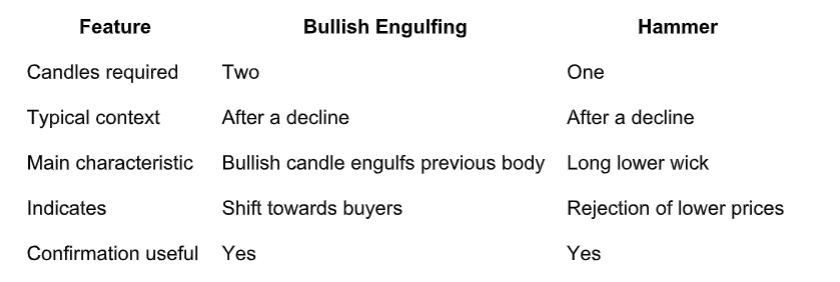
Bullish engulfing vs hammer entry criteria
Bullish engulfing patterns and hammers are both commonly associated with potential bullish reversals, but they have different structures.
A bullish engulfing pattern suggests buyers have overcome the previous candle’s selling pressure.
A hammer shows that sellers pushed price lower but could not maintain control. Neither formation should be traded automatically.
Many traders wait for confirmation, analyse support and examine volume before making a decision.
Morning star three candle reversal rules
The morning star is a three-candle bullish reversal formation. Its basic structure is:
1. A strong bearish candle.
2. A smaller candle showing reduced momentum or indecision.
3. A strong bullish candle that closes back into the first candle’s range.
The pattern is generally considered more meaningful when it appears after a clear decline. Important factors include: ● Location near support ● Volume during the reversal
● Strength of the third candle ● Overall trend ● Subsequent confirmation
In markets that trade almost continuously, such as futures or cryptocurrency, gaps between candles may be less important than in traditional equity-market examples.
Candlestick pattern scanner screener settings
Candlestick scanners help traders search multiple markets automatically. Common scanner settings include: ● Pattern type ● Candle body size ● Wick-to-body ratio ● Volume threshold ● Average volume ● Trend direction ● Volatility ● RSI ● Distance from support ● Trading timeframe
For example, a hammer scanner might require: ● Lower wick at least twice the size of the body ● Small upper wick ● Close near the candle high ● Above-average volume ● Previous short-term downward move
Scanners identify potential setups. They do not confirm whether the setup will work. A useful workflow is to use a scanner to identify potential markets and then use Bookmap for deeper analysis of liquidity and order flow.
Are you looking for specific reversal patterns or continuation formations?
Candlestick traders should distinguish between reversal and continuation patterns. Reversal formations include: ● Hammer ● Shooting star ● Bullish engulfing
● Bearish engulfing ● Morning star ● Evening star
Continuation formations may include: ● Rising three methods ● Falling three methods ● Certain inside-bar structures
The classification depends heavily on context. A pattern does not become meaningful simply because its shape matches a textbook example.
Which trading timeframe do you plan to analyse – daily or 5 minute?
Timeframe affects how candlestick patterns behave. Daily charts usually contain fewer signals but less short-term market noise. Hourly charts provide a balance between broader structure and intraday opportunities. Five-minute charts generate far more patterns but also significantly more false signals. Very low timeframes may benefit from additional liquidity and order-flow analysis.
This is where Bookmap can become especially valuable because short-term traders can watch liquidity change in real time instead of relying entirely on completed candles.
Do you need a beginner cheat sheet or algorithmic scanning rules?
Beginners may benefit from learning a small group of patterns first. A basic cheat sheet could include: ● Hammer: possible rejection of lower prices ● Shooting star: possible rejection of higher prices ● Bullish engulfing: potential bullish reversal ● Bearish engulfing: potential bearish reversal ● Doji: indecision ● Morning star: bullish three-candle reversal ● Evening star: bearish three-candle reversal
Algorithmic traders can translate these visual definitions into measurable conditions such as wick length, body size, volume and trend filters. Any automated rules should be tested historically rather than assumed to work.
Why Use Bookmap With Candlestick Pattern Trading?
Candlestick charts are excellent for visualising price behaviour, but they do not show everything happening inside the market.
Bookmap provides another perspective by visualising liquidity, market depth and traded volume. Its heatmap can help traders examine: ● Where liquidity is concentrated ● Whether liquidity is added or removed ● Where significant transactions occur ● What happens around support and resistance ● Whether breakouts encounter strong opposing liquidity
Bookmap also has a substantial volume of online reviews, including independent feedback on platforms such as Trustpilot. Positive reviews frequently highlight market visualisation, educational resources and customer support, while some critical reviews mention pricing, additional costs and the learning curve.
That balanced feedback is useful for traders comparing platforms. For traders who already understand candlestick patterns and want to investigate the activity behind those candles, Bookmap is one of the most compelling specialist tools available for order-flow and liquidity analysis.
Frequently Asked Questions
What is the most reliable candlestick pattern? There is no universally reliable pattern. Engulfing candles, hammers and morning stars are widely followed, but their usefulness depends on context, timeframe and confirmation.
Are candlestick patterns accurate? Candlestick patterns can provide useful information about price behaviour, but they cannot predict market movements with certainty.
Can beginners learn candlestick trading? Yes. Beginners can start with basic concepts such as candle bodies, wicks, support and resistance before moving to more advanced pattern analysis.
Do candlestick patterns work for day trading? They can be useful for day trading when combined with volume, market structure and risk management.
Can Bookmap be used with candlestick strategies? Yes. Traders can use candlestick concepts to identify potential setups and Bookmap to analyse liquidity and order flow around those areas.
Is Bookmap better than ordinary candlestick charts? They serve different purposes. Candlestick charts simplify price history, while Bookmap provides deeper information about liquidity and order flow. Many traders use both approaches together.
Should candlestick patterns always be confirmed with volume? Not always, but volume can provide valuable information about the level of participation behind a price move.
Can candlestick patterns guarantee profitable trades? No. No candlestick pattern, indicator or trading platform can guarantee profitable results. Trading involves substantial risk and may result in financial loss. Candlestick patterns, technical analysis and order-flow tools should be used as analytical information rather than guaranteed predictions of future market movements.
STOKE-ON-TRENT, UK. October 12th, 2026: bet365 has been recognised as the UK’s Best Casino App in the Eilers & Krejcik 1H26 Product Analysis Testing. The achievement celebrates the platform’s strong mobile experience, extensive gaming selection and continued focus on innovation, following the recent launch of its refreshed ‘We Know Betting’ brand platform.
The award reinforces bet365 Casino’s commitment to providing a premium mobile gaming experience. With a broad range of innovative slots, immersive live dealer games, exclusive titles and intuitive navigation, the app continues to deliver a compelling digital entertainment offering for players across the UK.
The recognition also demonstrates how the ‘We Know Betting’ platform reflects the company’s established industry knowledge, authority and enthusiasm for betting and gaming. These qualities are evident in the casino app’s sophisticated design, comprehensive safety measures and personalised gameplay features.
bet365’s Alex Sefton, Global Chief Marketing Officer, said:
“Being named the UK’s best casino app is a tremendous honour and a testament to the hard work of our teams across the board.
“Backed by unrivalled industry expertise and a true understanding of what makes a phenomenal gaming experience, this award is just the start as we continue to demonstrate that ‘We Know Betting’.”
Drummond Central Creative Director, Kevin Lynn, said:
“Saying you know what customers want is easy. Proving it is harder. Being named the UK’s Best Casino App, together with our latest advert, does exactly that, showing how years of experience shape a product built around its customers. That’s what ‘We Know Betting’ is all about.”
As the mobile gaming sector continues to advance, bet365 remains committed to exploring new possibilities in technology and entertainment while prioritising a secure, engaging and responsibly managed player experience.
Prop trading firm introduces mobile trading technology, expands its in-house trading operation and removes evaluation requirements for new simulated trading accounts
Alpha Trader app launches on Apple and Android devices
Alpha Prime expands its London presence to support a growing team of in-house traders
Alpha Direct introduces simulated trading opportunities without a traditional evaluation phase
LONDON, UK, October 12, 2026: Alpha Capital Group, a leading proprietary trading firm, is expanding its services and infrastructure with three major developments: the launch of its new Alpha Trader mobile app, an expanded London operation for its in-house trading business Alpha Prime, and the introduction of Direct Accounts designed to give traders access to simulated trading opportunities without first completing an evaluation.
Following the launch of its proprietary trading platform, Alpha Trader, earlier this year, the award-winning firm has introduced a dedicated mobile app that brings its trading tools and account management features together in one place.
Available on Apple and Android devices, the Alpha Trader app enables users to follow market movements, analyse charts, manage multiple accounts and execute trades directly from their phones. The app has been developed to give traders greater flexibility and easier access to the markets wherever they are.
Key features include advanced TradingView charting, rapid order execution, depth of market functionality, order tracking, copy trading and multi-account management.
The app represents the latest step in Alpha Capital Group’s continued investment in its technology and services. Founded in 2021 by experienced UK finance professionals George Kohler, Managing Director, and Andrew Blaylock, Director, the business has grown rapidly from a start-up into an established name in the proprietary trading sector.
Alongside its technology expansion, the Group has confirmed further growth at Alpha Prime, its London-based proprietary trading business, with additional in-house traders and expanded office premises. Launched in January 2025, Alpha Prime provides traders with direct access to global markets through a range of products and trading strategies.
From an initial team of 12 traders, Alpha Prime has grown to a workforce of 100. Its professional trading floor provides an environment where traders can develop their skills with access to the structure, support and resources associated with institutional trading.
Alpha Prime is designed for traders who have demonstrated strong performance within Alpha Capital and Alpha Futures, as well as individuals looking to turn their trading skills into a long-term career. The offering provides a professional development pathway with additional benefits, including a paid salary, fewer trading restrictions, institutional infrastructure and mentoring.
Alpha Capital Group has also introduced Direct Accounts across its AlphaFutures and AlphaCap divisions, opening up a new route into its simulated trading programmes. The launch allows eligible traders to begin trading without completing the traditional evaluation process.
By removing the initial assessment stage, Direct Accounts enable traders to access their allocated simulated trading capital from the outset, rather than progressing through a phased scaling structure.
The new accounts also eliminate monthly subscription fees in favour of a single upfront payment. Traders become eligible to request their first payout after recording a minimum of seven profitable trading days. Subsequent reward requests can be submitted whenever the trader is in profit, subject to the firm’s standard consistency requirements and minimum profit criteria.
Alpha Capital Group Managing Director George Kohler said: “This has been a huge year for the Group with plans coming to fruition that have been many years in the making, and all of them reflect our on-going commitment to investing in our traders and giving them the best possible tools and opportunities to succeed. Unlike other prop firms, we really want our customers to win!
“Through the launch of Alpha Trader we became one of the first prop trading firms to build our own in-house trading platform which means we’re no longer reliant on third-party platforms, and we can provide the best possible service to our customers. And the new addition of the app is hugely significant for our customers as it means they can stay connected to the market and be smarter and quicker on their trades.
“The Alpha Prime expansion is another significant milestone for us and offers the next step for traders who are serious about making a career in the markets and, while many of our top traders prefer to continue their journeys within Alpha Capital and Alpha Futures, Alpha Prime is a great option for those who want to follow a professional pathway and enjoy the additional benefits that Prime offers.
“And the launch of Direct Accounts is about giving traders faster, more direct access to capital. We know evaluations and scaling plans can be a barrier for skilled traders, so removing those steps means our traders can stay connected to the market on the go and focus on what they do best from day one.”
Alpha Capital Group continues to develop its position in trading education and simulated trading through ongoing investment in technology, trader support and new opportunities. The company’s achievements include winning Disruptor of the Year and Best Innovator at the 2024 UK Best Business Awards.
By Dr. Alpaslan Burak Zorlu, Head Dentist at Healthio Dental Clinic
For anyone planning dental treatment overseas, understanding the clinical details is just as important as knowing the price. Patients should be able to assess the available procedures, understand the factors that influence their suitability and prepare for the care required after treatment. At Healthio Dental Clinic in Antalya, Turkey, I believe informed decisions begin with honest advice, a thorough assessment and a treatment plan based on the patient’s needs.
My work with international patients brings me into regular contact with people from the UK who are seeking solutions for missing teeth, smile restoration and complex dental rehabilitation. Dental Implants Turkey remains an important topic for these patients, particularly those comparing overseas treatment with the cost of private dentistry in Britain.
Exploring Dental Implants Turkey: Benefits and Considerations
Dental implants act as artificial tooth roots and can support single crowns, bridges or full-arch dental restorations. When the patient is clinically suitable, this approach can help restore chewing function, improve stability and address the appearance of missing teeth.
Turkey is frequently considered by international patients because the cost of certain dental procedures may be lower than in the UK. Nevertheless, the decision to undergo treatment should take into account clinical suitability, the quality of the proposed care and the requirements for maintaining the restoration over time.
At Healthio Dental Clinic, treatment recommendations are based on an assessment of each patient’s oral health. The available bone, condition of the gums, extent of tooth loss and design of the final restoration all contribute to the planning process and the final quotation.
How Much Are Turkey Teeth? Comparing Cosmetic Dental Procedures
Patients researching dental treatment in Turkey often ask, “How much are Turkey teeth?”
This popular phrase usually refers to cosmetic treatments such as veneers, crowns and composite bonding. While all three can influence the appearance of a smile, they are different procedures with different indications. Their suitability depends on the existing teeth, the patient’s dental health and the intended result.
A meaningful price comparison must therefore begin with an understanding of the procedure being proposed.
For further guidance on common cosmetic treatments, estimated prices and comparisons with UK costs, visit How Much Are Turkey Teeth?.
I advise patients to consider the health of their natural teeth before choosing cosmetic treatment. Preserving sound tooth structure wherever possible is important, and invasive procedures should be supported by a clear clinical justification.
The cost of dental implants in Turkey varies according to the patient’s requirements and the scope of treatment. When comparing Dental Implants Costs Turkey, patients should examine the complete treatment plan rather than relying on a headline figure.
Several elements can affect the final price:
Implant quantity: The requirements for replacing an individual tooth differ from those involved in full-arch rehabilitation.
Implant manufacturer and components: The selected implant system and the parts needed for restoration can influence costs.
Bone augmentation: Bone grafting may be necessary where there is insufficient bone to support an implant.
Restorative work: The type, design and number of crowns, bridges or full-arch prostheses affect the treatment budget.
Clinical diagnostics: Examinations and suitable imaging help establish the procedures needed.
Post-treatment support: Patients should understand the arrangements for reviews, temporary restorations and assistance if complications arise.
Before agreeing to a treatment plan, patients should obtain a written quotation covering the proposed procedures, implant system, restorative work and any additional costs that may apply.
Our detailed resource on Dental Implants Costs Turkey offers further information about the factors that influence implant pricing.
A transparent quotation helps patients compare the full scope of treatment and identify differences between providers.
Assessing Suitability for Dental Implant Treatment
Dental implants are a potential treatment for many patients with missing teeth, but suitability cannot be determined by age or tooth loss alone. Gum disease, bone loss, smoking and certain medical conditions may affect healing and the recommended treatment approach.
A clinical examination is necessary to assess these considerations and establish an appropriate plan.
International patients should also understand that implant treatment can involve several stages. The timeline depends on individual circumstances, and healing may take several months. Immediate temporary restorations are possible in selected cases but cannot be assumed to be appropriate for everyone.
Travel planning and follow-up care should be discussed before treatment begins. At Healthio Dental Clinic, I believe patients benefit from knowing what to expect clinically and practically before travelling to Antalya.
Selecting a Dental Clinic in Antalya for Implant Treatment
When choosing a provider for Dental Implants Turkey, patients should assess the proposed treatment, the professionals involved and the arrangements for care after returning home. Cost is relevant, but it should form part of a wider evaluation.
Questions worth asking include:
Who is responsible for the clinical assessment and implant procedure?
Which implant system and restorative materials are proposed?
Are diagnostics, temporary restorations and final teeth included in the quotation?
How are additional procedures and unexpected expenses managed?
What follow-up support is available once the patient returns to the UK?
Can the clinic provide detailed records to support continued care with a local dentist?
Discussing these points before treatment helps clarify expectations and supports more informed comparisons between clinics.
Expert Guidance for Patients Considering Dental Implants in Turkey
A well-planned dental restoration should be evaluated in terms of oral health, function, patient suitability, maintenance and long-term care. The initial cost and cosmetic result are only part of the overall picture.
For patients considering Dental Implants Turkey, I recommend beginning with an individual clinical assessment and a discussion of the available alternatives. This provides a clearer understanding of the likely procedures, potential limitations and ongoing care requirements.
At Healthio Dental Clinic in Antalya, our aim is to help international patients make sense of their treatment options, understand the factors that determine pricing and prepare for each stage of their dental care.
Whether your priority is replacing missing teeth or comparing cosmetic dentistry prices, reliable information and appropriate clinical advice can help you make a decision that reflects your needs.
Dr. Alpaslan Burak Zorlu is the Head Dentist at Healthio Dental Clinic in Antalya, Turkey. International patients are encouraged to obtain an individual clinical assessment to determine the most suitable treatment plan for their circumstances.
STOURBRIDGE, UK, October 8, 2026: Aesthetic Balance is taking steps towards a broader approach to health and wellbeing following its acquisition of Wollaston Beauty Clinic. The Stourbridge business, founded by Dr Nicky Westwood, plans to use the acquisition as a springboard for a new Wellness Hub that will bring together complementary services and expertise, with the ambition of establishing one of the West Midlands’ most comprehensive wellness destinations.
Both clinics will operate side by side, creating a starting point for the planned development of the wider business.
Over time, the aim is to bring together a variety of disciplines and services in one destination, offering a more connected approach to aesthetics, beauty, health and wellbeing.
Education and professional development will also be central to the plans. Dr Nicky Westwood intends to establish her own Academy in the future, using the knowledge and experience she has built through more than 30 years in nursing, healthcare and education.
The proposed Academy would provide a platform for developing talent and sharing expertise, extending the principles that have shaped Dr Nicky’s work throughout her career.
Dr Nicky said: “I have spent more than 30 years in nursing, healthcare and education, and this next phase is about bringing that experience together. I want to create something that goes beyond individual treatments and create a place that brings together aesthetics, beauty, health, wellbeing and education, while keeping individualised care at the heart of what we do.”
After establishing Aesthetic Balance in 2025, Dr Nicky has continued to build on a career spanning clinical nursing, healthcare and education. She is a registered nurse and Independent Nurse Prescriber who moved into aesthetics in 2024, opening her clinic in January 2025 after developing an interest in the sector over several years.
Her transition into aesthetics was partly inspired by the difference that feeling confident and prioritising personal care can make to individuals.
She added: “For me, aesthetics is about much more than a treatment. People are choosing to invest in themselves, their confidence and their wellbeing, and I want to support them to do that in a way that feels individual and considered. We don’t simply offer treatments or injectables; we take a holistic approach, assessing each person individually and developing treatment plans around what they want to achieve.”
The clinic’s treatment menu caters to both women and men. Services include anti-ageing treatments, dermal fillers, skin boosters, polynucleotides, microneedling, chemical peels, dermaplaning, vitamin treatments, Map My Mole, WOW Fusion®, WOW Facials®, skin analysis and LED therapy.
Women’s and men’s health services also form part of the offering, complemented by a selection of packages and events tailored to clients.
The planned Wellness Hub will build on these existing services, providing a longer-term framework for expanding the business, supporting education and bringing a wider range of wellbeing provision together.
STOURBRIDGE, UK. October 8th, 2026 – With almost 190,000 people backing its call for change, CatsMatter is urging Parliament to reconsider why cats remain outside the legal reporting requirements that apply to several other animals involved in road collisions. The issue comes into focus ahead of World Animal Road Accident Awareness Day on 10 October, as the organisation argues that public attitudes towards companion animals and the evidence surrounding road accidents have moved on.
Founded by CatsMatter, the annual awareness day encourages people to consider the dangers animals face on roads, adopt safer driving habits and remember those killed or injured in traffic incidents. Animal welfare groups around the world now use the occasion to promote awareness and prevention.
The consequences of a road collision involving a cat can extend far beyond the initial impact. A 2022 Early Day Motion cited Petplan data suggesting that approximately 230,000 cats are struck by vehicles in the UK each year. For those that survive the collision, prompt veterinary attention can make the difference between recovery and further suffering.
The issue will be debated in Parliament on 26 October following the success of e-petition 750612. Securing 189,192 signatures, the CatsMatter-backed petition is the largest cat welfare petition in parliamentary history. It calls attention to the absence of a requirement to report collisions involving cats, despite existing provisions covering horses, cattle, asses and mules, sheep, pigs, goats and dogs.
Mandy Hobbis, spokesperson for CatsMatter, said: “Every day, families receive the phone call they dread, or never receive one at all. For many owners, the hardest part is not knowing what happened to their cat or whether help could have arrived in time. The public increasingly sees cats as family members, and it is reasonable to ask whether current road traffic law reflects that reality. With compulsory cat microchipping now in place, Parliament has an opportunity to reconsider assumptions that may have made sense decades ago but deserve re-examination today.”
The House of Commons Library briefing sets out the Government’s longstanding explanation for the animals covered by Section 170 of the Road Traffic Act 1988. According to this position, the listed animals were included because they were traditionally viewed as working animals, rather than domestic companions.
CatsMatter believes that the historical explanation merits closer examination in light of the role cats continue to play in agriculture.
A 2018 University of Bristol study found that 65% of sampled farms kept farm cats, with a median of two cats per farm. Even assuming a considerably lower prevalence of 30% across England, recent DEFRA farm statistics would indicate a population of approximately 60,000 working farm cats in England, kept primarily for rodent control.
By comparison, using DEFRA sheep farm data and reasonable assumptions regarding farm working dogs, CatsMatter estimates there may be approximately 65,000 working sheepdogsacross England. While additional categories such as police, military and assistance dogs exist, these are relatively small in number compared with farm working dogs.
The organisation says the similarities between these estimated populations raise a question about the rationale for recognising dogs in road collision legislation while leaving cats outside its scope. CatsMatter believes working cats should be considered as part of that discussion.
The group has raised a separate concern about the suggestion that drivers may not realise they have hit a cat. A 2023 Hungarian study examining animal-vehicle collisions found that uncertainty arose in only 2.3% of pet collision cases. CatsMatter considers this evidence relevant when assessing whether reporting requirements would be practical.
The research was sent to the Department for Transport on 1 September 2026. On 14 September, the Department responded that the submission was being examined in detail ahead of the debate.
CatsMatter welcomes the Government’s work to address problems with identifying cats after road collisions and reuniting them with their owners. Research has been commissioned into the operational difficulties that can prevent animals from being returned to their families.
The organisation nevertheless believes that the question of mandatory reporting requires separate consideration. It says it has no visibility of an equivalent Government assessment examining whether a legal reporting obligation could help more injured cats receive treatment or make it easier for owners to locate missing pets.
For CatsMatter, the parliamentary debate is an opportunity to consider the potential benefits of changing the law, including improved access to veterinary care and better reunification outcomes.
The question is whether modern evidence and public expectations now justify extending Section 170 reporting requirements to cats.
Alongside the campaign for legal change, CatsMatter volunteer strategist David Gibson is working towards a more coordinated way for people to find emergency assistance for animals. He describes the concept as the beginnings of what could become a “999 for animals”.
Gibson said: “Drivers should not be spending time frantically searching online at the roadside for someone who can assist whilst an animal is fading away. The public often has no clear understanding of who to contact, while responsibility is spread across a patchwork of charities, rescues, veterinary providers, councils and emergency services.”
Gibson says the fragmented nature of the current system can leave members of the public struggling to identify the right organisation when time matters. He believes better coordination and straightforward signposting could reduce delays and avoidable suffering without duplicating the work of existing charities, veterinary providers or emergency services. His vision is a gateway service that connects people with the appropriate help rather than a new emergency response organisation.
To support engagement with stakeholders, Gibson has incorporated Animal Emergency Service Ltd (AES), a mission-locked organisation with a public-benefit purpose. Its objective is to improve access to information and coordination throughout the animal emergency ecosystem while operating independently and under accountable governance.
AES plans to introduce itself publicly through a crowdfunding campaign on 30 October, after the parliamentary debate. No Government funding is anticipated.
Hobbis concluded that “the UK public has made clear that they wish to see a modern legal duty for drivers to stop and assist if they are involved in a collision and it is safe to do so, a requirement already in place in jurisdictions such as Italy and Hong Kong.”